Automated
Since solar activity strongly influences the Earth’s atmosphere, solar activity forecasts are critical inputs into modern atmospheric density models.
Improving solar activity forecasting accuracy can therefore lead to improved estimates of atmospheric drag force and, consequently, trajectory state and covariance. Given that the consequences of atmospheric mismodeling can be catastrophic – i.e., a collision and the resulting pollution of the space environment with an influx of debris fragments – accurately forecasting future solar activity is essential for safe and efficient space operations, potentially reducing uncertainty, unnecessary fuel expenditure, and collision risk.
The 10.7cm solar radio flux (F10.7) correlates strongly with the 11-year solar cycle and serves as a critical input into many atmospheric density models due to its strong (linear) relationship with atmospheric temperature. Several F10.7 forecasting models exist; many long-term forecasting models, like the Schatten F10.7 model, require periodic manual re-fitting by a subject matter expert, and no widely accepted near-term model regularly and automatically retrains on new data as it becomes available.

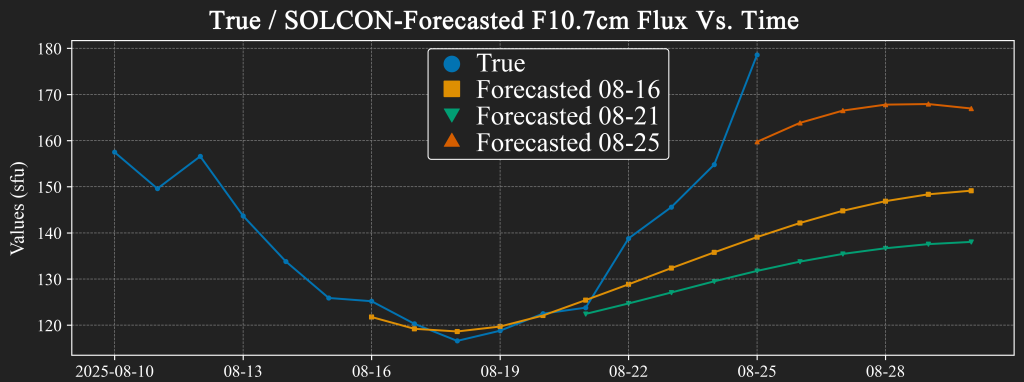
This investigation details and characterizes the performance of a dynamically updating, highly accurate, near-term F10.7 forecasting model dubbed “SOLCON”, enabling better atmospheric density predictions, improving downstream analyses, and allowing mission operators to make more informed decisions about the space environment.
The SOLCON forecasting model leverages long short-term memory networks (LSTMs), a type of artificial neural network that is especially well-suited for learning patterns in sequential data. Two key hyperparameters, the lookback and lookahead indices, define how many past observations the model uses to make its predictions and how far into the future the model predicts in a single inferencing step. Model outputs can be concatenated with previous inputs such that each inferencing step forecasts one timestep further into the future, thus allowing forecasts of any arbitrary length. The model is trained on data from January of 1963 through December of 2001, and additionally on data from January 2024 through the present.
Two distinct, contiguous, 11-year timespans are reserved for forecaster evaluation – one for experimentation of model hyperparameters in search of the best performing configuration, and one for a final performance evaluation of the best selected model. For each day in these 11-year timespans, a 60-day forecast starting on that day is generated. All forecasts (over 4,000) in a given timespan are then aggregated to compute the error mean and variance per-timestep.
This evaluation process reveals that the SOLCON model predicts near-term F10.7 behavior more accurately than all considered baseline methods (long-term Schatten forecaster, persistence forecaster, linear regression forecaster). A higher accuracy score, based in symmetric mean absolute percentage error, is sustained throughout 35-day forecast horizons. SOLCON also demonstrates a lower root mean squared error for up to 22-day forecast horizons and lower or near-identical error variance through 60-day forecast horizons.


The regular regeneration of forecasts, combined with online training using new observations as they become available, enables the SOLCON forecaster to respond effectively to the most recent fluctuations in observational data, thus ensuring the model’s utility in operations-focused applications where a clear picture of immediate-term solar activity is necessary.