
FreeFlyer Engineering Team
As reusable launch vehicles and on-orbit servicing, assembly and manufacturing concepts mature, the case for long-duration park orbits grows. Rather than launching and departing in quick succession, future missions may need to loiter in LEO for days at a time before heading to their destination. The question is whether that flexibility is worth the fuel cost, and how to minimize it.
In our recent webinar, Justin Hartland explored the complexities of Optimizing Long-Duration Park Orbits for Earth Escape Trajectories. This research, originally presented at the AAS Rocky Mountain Conference, dives into the mission design impacts of long-duration park orbits for interplanetary missions.
The Challenge: The Cost of Loitering
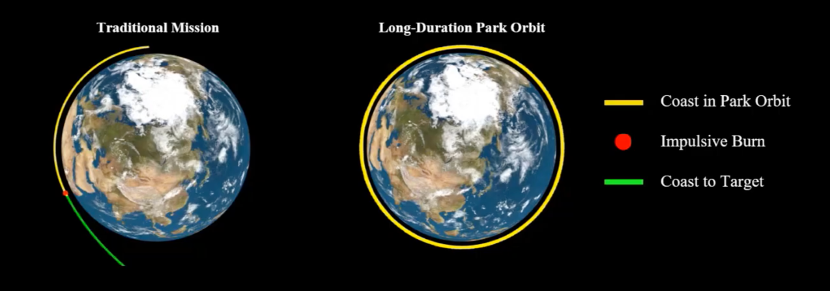
Most traditional missions use a short park orbit, think 30 minutes to a few hours, before the final burn. However, certain advanced mission architectures (such as those involving on-orbit assembly or refueling) may require the spacecraft to loiter for several days or weeks.
The challenge is that the longer a spacecraft loiters, the more its orbital plane drifts relative to the intended departure direction, a consequence of Earth’s oblateness acting on the orbit over time. Left unmanaged, this growing misalignment translates directly into a more expensive escape burn.
Methodology
To investigate this, the study modeled a representative set of Mars mission trajectories using POST2 (Program to Optimize Simulated Trajectories II), a NASA trajectory optimization tool. The study was structured around two sequential analyses:
- Baseline Analysis: Examined how delta-v costs vary when departing from a commonly used park orbit across a 21-day period, establishing a baseline understanding of the problem.
- Parametric Study: Built on those findings to identify the optimal park orbit geometry that minimizes delta-v over the same period.
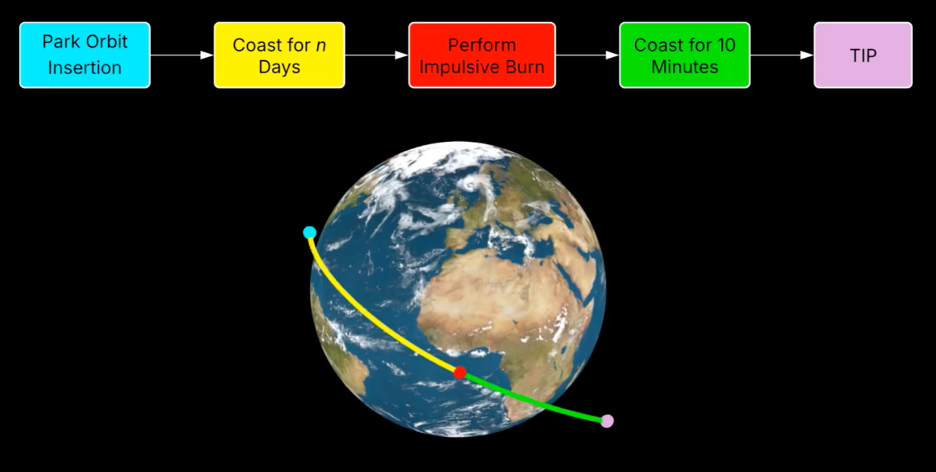
For each analysis, 21 trajectories were evaluated across the departure period, each adding roughly one additional day of loitering before executing an escape burn. The timing and direction of each burn were optimized to meet that day’s precise departure requirements, defined by the required departure direction (RLA/DLA) and escape energy (C3), while minimizing delta-v.
Results and Conclusions
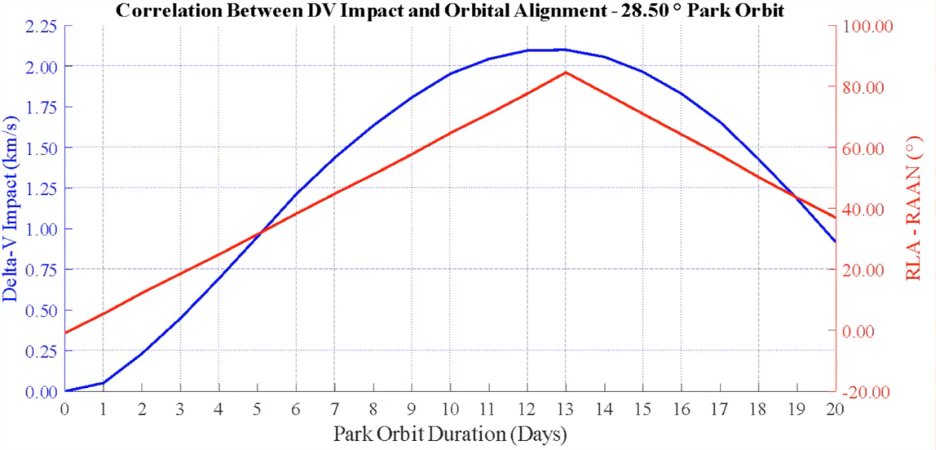
When using a conventional 28.50° inclination park orbit, delta-v impact grows significantly with loiter duration. The misalignment between the orbital plane and the outbound departure direction changes over time, rising sinusoidally to a peak midway through the 21-day window before partially recovering, making long-duration loitering prohibitively expensive under this configuration.
Every orbit processes at a rate determined partially by its inclination, and the departure direction (RLA) shifts at its own rate over the launch period. By selecting an inclination where these two rates closely match, the orbital plane effectively tracks the departure direction throughout the loiter period, keeping the escape burn efficient regardless of how long the spacecraft waits.
Key Takeaways for Mission Designers
- Nodal precession as a design lever: Matching the nodal precession rate to the departure trajectory’s rate of change is the central mechanism for efficient long-duration park obits of this design.
- Optimal inclination is mission-specific: The optimal park orbit inclination will vary depending on the daily-varying departure trajectory targets.
- Further trade-offs remain: Future study must weigh these delta-v savings against the launch costs of a high-inclination orbit and propellant boiloff losses.
Watch the Technical Breakdown
If you’re interested in seeing the full analysis and FreeFlyer visualizations that bring these trajectories to life, watch the webinar below: