
University Students
Great careers for college grads
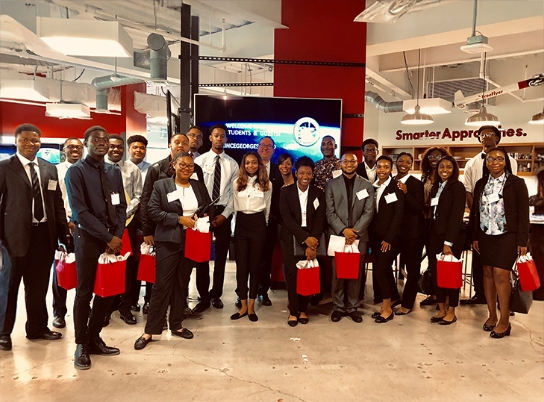
We are committed to supporting academic excellence by providing you with hands-on experience in both technical and professional development skills needed to enter the workforce after college. We offer college students, in select programs of study, paid internships where you will contribute to real space mission projects within the organization. Many of our internships will lead to full-time positions at one of our locations in the United States.
View Job OpportunitiesThe FreeFlyer University Program
FreeFlyer is available for FREE for university use. Join the many universities across the world already using the FreeFlyer astrodynamics software as a part of their curriculum.
Visit FreeFlyer University
Real internship stories

My name is Rohit Goeptar, and I am currently a student at University of Central Florida double majoring in Computer Engineering and Electrical Engineering. I will be graduating Fall of 2025 with a Bachelor’s in Computer Engineering and Spring 2026 with a Bachelor’s in Electrical Engineering.
This summer, I was able to experience my first internship experience while being in college with
a.i. solutions which was an amazing experience. I was fortunate and had the opportunity to work with the EMC/EMI/RF group at Kennedy Space Center. During my internship, I was able to provide support to NASA’s Launch Services Program by building lightning models within CST STUDIO, which consisted of different variations of the spacecraft’s umbilicals, lightning strikes simulated at various distances, and using multiple different solvers to calculate necessary data. A spacecraft’s umbilical is a crucial component that facilitates the transfer of various essential resources to the spacecraft like power, communications and telemetry. Purpose of these simulations was to test the magnetic/current coupling induced by high magnitude lightning events. Lightning is detrimental to any spacecraft that launches; therefore, this project was extremely important to the team, giving us a better understanding of how lightning affects our spacecraft/launch vehicles. Ultimately, resulting in mission success whether it is for our planetary missions or simple payload missions. Every day I had the opportunity to learn something new. A few things that I learned were what it takes to launch a vehicle and the daily operations here. Also, I had the opportunity to learn new softwares and had the pleasure to meet some of the most knowledgeable engineers in the industry. This internship gave me the tools and knowledge that I can carry anywhere I go in life.

I am Simon Hart and I am interning with the Electrical Ground Support Equipment (EGSE) team at NASA's Launch Services Program (LSP). In Spring 2025, I graduated from Florida State University with a Bachelor’s in Electrical Engineering and am planning on returning in the Fall for my Master’s in Electrical Engineering through the pathways program. This is my second internship, and I came in with the goal of gaining experience in an aerospace engineering environment.
This internship has been invaluable to my growth as an engineer. I have had the opportunity to work with and consult many professionals who have all been helpful, supportive, and very knowledgeable on a wide range of topics. I was able to contribute to the EGSE team by developing on-console display pages that will be used during commercial launch provider launches. I was able to verify specific safety configurations during a transition to a new type of automating computational module for the Crew-11 launch being used on the launchpad. I also created a database for all the electric heaters that are used at multiple pads and will provide a useful reference when the team needs to dive into details on specific heaters. I was provided the opportunity to sit on-console for the Crew-11 launch, go on a handful of exciting tours, attend various weekly meetings, and provide meaningful contributions that the EGSE team will use for years to come. I had an amazing experience at this internship and am very appreciative of this opportunity to intern for a.i solutions!

My name is Alex Key, and I'm a rising junior in aerospace engineering at NC State University. I supported the FreeFlyer development team as a software engineering intern in the summer of 2025. I bounced between a couple different projects, including the development of a heat map, parsers for different types of file inputs, and debugging the FreeFlyer scripting language. Working in the software's code-base required me to learn a new coding language that was more complex than those I've worked with in the past, and it also required me to learn how to work in and search through a large number of files. Learning where to start when searching for certain features or who to ask when I'm trying to understand the structure of the program helped accelerate the progress, and I always felt very welcome to ask questions and get to know my coworkers, even if I couldn't meet them face-to-face! Luckily, I did get to meet the other FreeFlyer intern in person since we are a part of the same fellowship.
I think my favorite project was probably the OCM Parser project. Orbital Comprehensive Messages are very extensive files describing the state of an object in orbit. Since my major is in aerospace engineering, a lot of concepts in astrophysics were pretty new to me. It was really interesting to research the different reference frames we use when trying to place objects in space, or what measurements/values we need to use to describe the position and movement of objects. Interpreting large files like OCMs means having to map existing FreeFlyer functionality to specific data stored within, and I really enjoyed bridging the gap between what the file wants us to know and what the software can do with that data. The reason I'm pursuing a computer programming minor is because I want to be able to bridge the gap between software and hardware/mechanical systems in the future, and I feel this internship was the first step in learning how to bridge those kinds of gaps.

My name is Sarine Mardirosian, and I am a class of 2026 Columbia University student majoring in astrophysics and minoring in math. This summer, I was a FreeFlyer Software Engineering Intern on the Technical Support team working to create Sample Mission Plans for publishing on future FreeFlyer releases.
My previous experiences in software have mostly involved data collection and processing, but the FreeFlyer software engineering experience was very different. Building Mission Plans from scratch was a use of software I had never engaged with before, and it was deeply transformative to see how software is so tangibly used in aerospace.
I genuinely had so much fun coding for FreeFlyer this summer, and am immensely grateful to the FreeFlyer team for welcoming me and being so willing to nurture my interests. Even remotely, everyone on the team was eager to engage with me and one another, which created a collaborative, genuine, and meaningful work environment. It became clear that all the members of the FreeFlyer team care tremendously about what they do and the people they work with, which is reflected by the quality of their work. I am lucky to have been a part of such a team.

Hello, I am Sammy Quigg, a rising senior at the University of Massachusetts - Amherst. Next spring, I plan to graduate with a B.S. in Mechanical Engineering and with a certificate in aerospace engineering. This summer, I supported the propulsion group of NASA's Launch Services Program (LSP) via
a.i. solutions. My main task with the propulsion group was to extend a data analysis tool to be more comprehensive, allowing for static fire data to be interpreted, not just launch data. The new tool will allow data to be viewed and approved much more quickly which is important considering the quick turnaround between a static fire and the launch. Despite my internship project being primarily software based, I learned a lot about rockets and the launch industry. This internship being my first, I also learned how to navigate a professional workplace and work with a technical team. The propulsion group was especially affable and I thoroughly enjoyed my time working with the LSP crew. There were many exciting tours offered, as well as opportunities to independently explore historic sites at Kennedy Space Center and Cape Canaveral Space Force Station. I am very appreciative for this opportunity presented by
a.i. solutions to create a new tool for LSP to use and allow me to develop my professional skills.

I am Dylan Rubio, and I attend the University of Central Florida studying Mechanical Engineering. I am a Mechanical Launch Vehicle and Mechanical Ground Support Equipment intern for NASA's Launch Services Program. My goal was to learn as much as possible about mechanical systems and flight hardware, while gaining valuable professional experience. My time working at a.i. solutions has been a very exciting experience. Everyone I worked with has been extremely helpful and friendly. A project I got the opportunity to work on this summer was the ground system guide to help engineers by them referencing it when they are on console supporting a launch. My favorite project I got to work on is developing a vehicle integration simulation in CAD software to show to the different groups how the stacking and encapsulation is preformed. I also provided a reference guide to compare different mission spacecraft purge information because each mission has slightly different requirements and hardware. I have gained knowledge on vehicle integration and ground systems during my time working for a.i. solutions. This internship has supported my future goals by giving me experience and knowledge to work in a professional setting. I am very interested in working in a future position at a.i. solutions.