FreeFlyer Engineering Team
Introduction
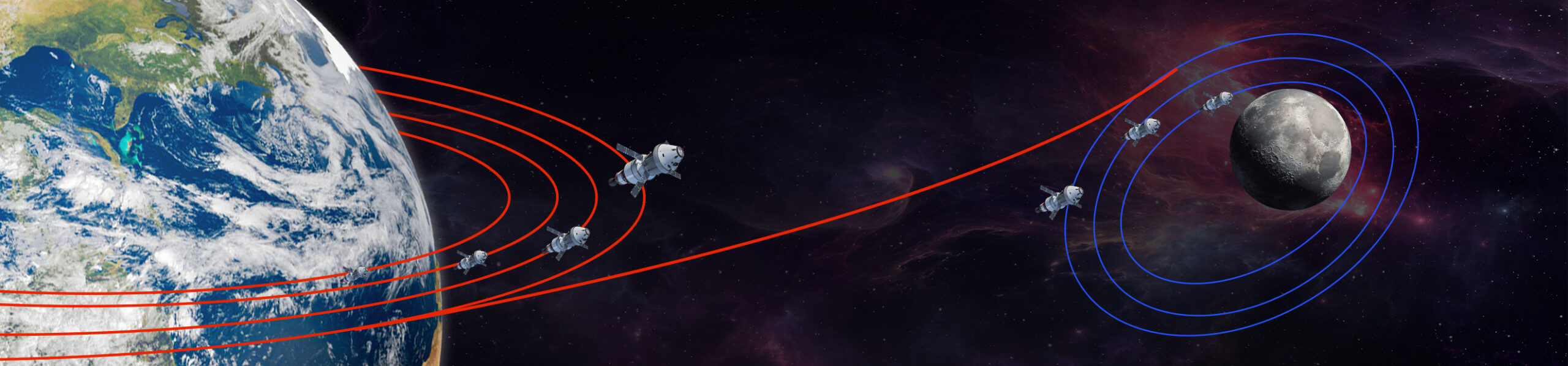
SpaceX recently announced plans to migrate more than 4,400 Starlink satellites to a lower orbit by the end of 2026. While this decision may seem counterintuitive from a traditional perspective of satellite lifetime and atmospheric drag, it is supported by a predictable Solar Cycle Progression that governs thermospheric density trends. Under the right conditions, this altitude shift will ultimately increase space safety.
Using FreeFlyer, we analyzed how atmospheric density and orbital decay will evolve over the next several years of the solar cycle across relevant altitudes. The results show that epoch-dependent density changes can outweigh altitude differences as we approach solar minimum, making lower operational shells both practical and strategically beneficial.
FreeFlyer Analysis Overview
We conducted our analysis in FreeFlyer using the MSIS-2000 atmospheric density model, with relevant solar activity values provided by the CelesTrak Space Weather file. Our simulations span circular orbits initialized at altitudes of 480 km and 550 km, with start epochs on January 1 of 2024, 2025, 2026, 2027, and 2028. These orbits were propagated forward until reaching a deorbit altitude of approximately 120 km.
All scenarios were modeled as passive, decay-only trajectories, without applying station-keeping or orbit-raising maneuvers. This approach isolates the combined effects of orbital altitude, epoch-dependent thermospheric density, and solar-driven drag. We chose the initial conditions to capture how atmospheric conditions evolve and how these changes influence orbit decay time.
Thermospheric Density Structure
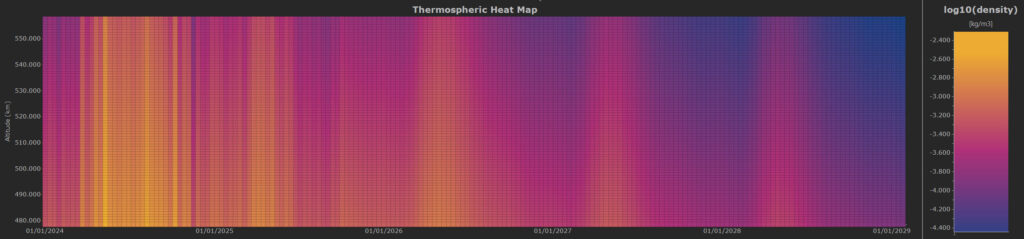
Figure 1 illustrates the decrease in thermospheric density over the next several years as the solar cycle progresses towards solar minimum. As extreme ultraviolet (EUV) radiation output decreases, the upper atmosphere cools and contracts, reducing effective drag across the 480 to 550 kilometer altitude band relevant to Starlink-class satellites.
As a result, density at 480 kilometers in later years becomes comparable to, and may eventually be lower than, density at 550 kilometers in earlier years. This erodes the traditional lifetime advantage of operating at higher altitude and highlights the importance of accounting for time when evaluating the drag environment.
Orbital Decay Crossover
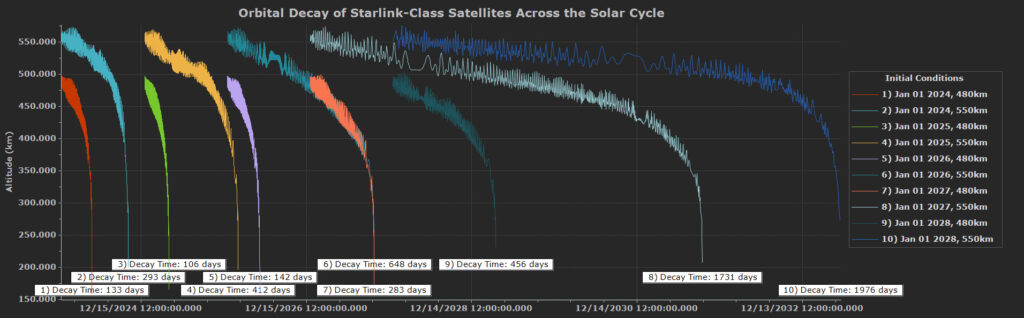
Figure 2 shows orbital decay times under varying initial altitude and epoch conditions. As the system approaches solar minimum, the average decay times increase rapidly at both 480 and 550 km altitudes. This trend continues until a lower altitude case that begins later in the timeline (e.g., IC #9) ultimately takes longer to naturally deorbit than a higher altitude case that begins earlier in the timeline (e.g., IC #4).
This crossover demonstrates that epoch-dependent atmospheric conditions can dominate altitude alone when determining appropriate orbit altitudes for a given mission. Therefore, in the context of mission design, altitude decisions should be evaluated within the broader context of the evolving solar cycle.
Implications for Starlink Operations
From an operational standpoint, lowering altitude during this phase of the solar cycle does not impose a disproportionate decay penalty. Instead, it offers several advantages, including predictable natural deorbiting at end of life and improved long-term debris mitigation, which ultimately promotes space safety.
References
- Space.com
SpaceX lowering orbits of 4,400 Starlink satellites for safety’s sake.
Reporting on SpaceX’s announced plans to lower operational Starlink altitudes to improve debris mitigation and long-term space safety.
https://www.space.com/space-exploration/satellites/spacex-lowering-orbits-of-4-400-starlink-satellites-for-safetys-sake - NOAA Space Weather Prediction Center
Solar Cycle Progression.
Official tracking of solar activity trends, including progression toward solar minimum and associated impacts on the upper atmosphere.
https://www.swpc.noaa.gov/products/solar-cycle-progression - CelesTrak
Space Weather Data (Last 5 Years).
Historical solar and geomagnetic indices used for space environment modeling and atmospheric density analysis.
https://celestrak.org/SpaceData/SW-Last5Years.txt