FreeFlyer Engineering Team
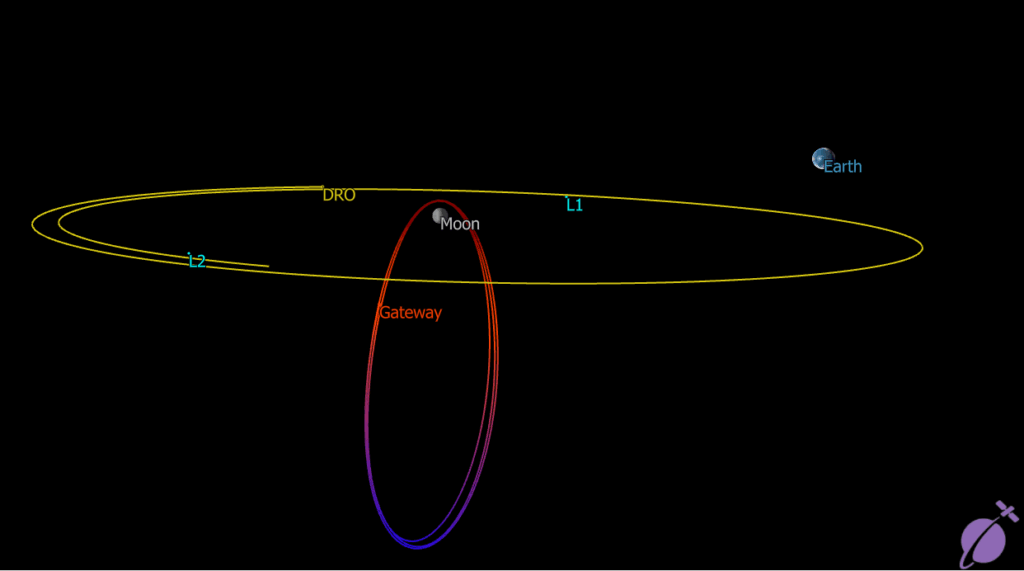
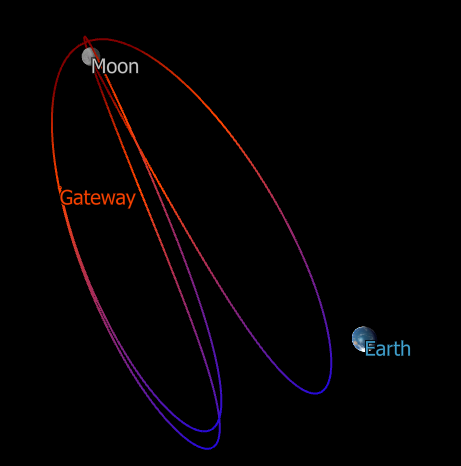
One of the most exciting and challenging aspects of Artemis is NASA’s planned Gateway space station, which will orbit the Moon. Gateway will reside in a unique Earth-Moon L2 Near-Rectilinear Halo Orbit (NRHO) in a 9:2 lunar synodic resonance. This orbit takes advantage of a balanced gravitational dance between Earth and the Moon, coming as close as 1,400 km to the lunar surface and extending as far as 70,000 km. Although the NRHO is nearly stable, it will still require regular orbit maintenance maneuvers once per revolution.
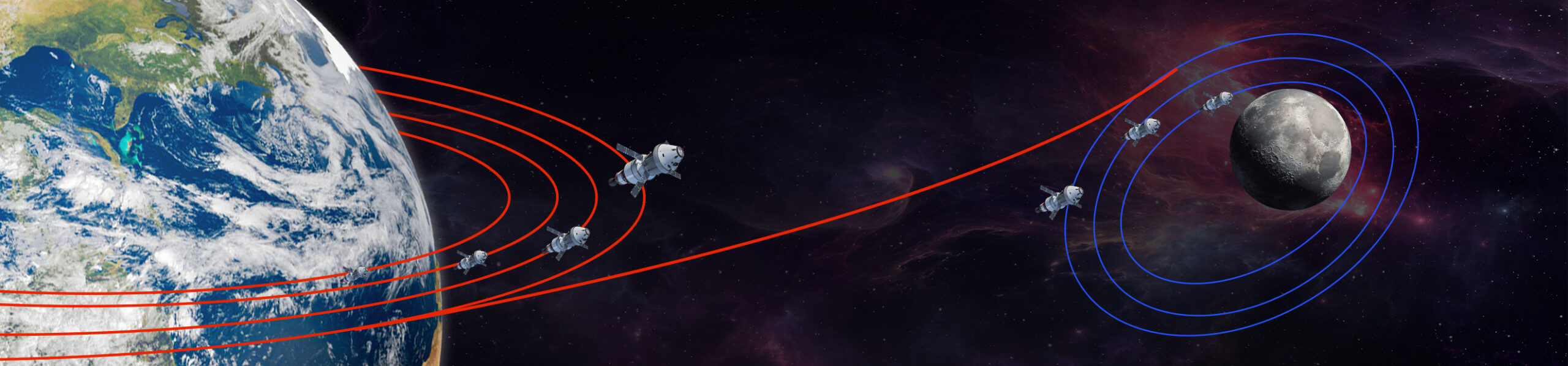
According to NASA, Gateway will depart Earth aboard a commercial launch vehicle and spend approximately one year gradually transiting to its NRHO, leveraging its low-thrust solar electric propulsion engines. The transit trajectory, led by NASA’s Glenn Research Center PPE mission design team, is divided into four distinct subphases: spiral subphase, alignment subphase, ballistic subphase, and insertion subphase [1][2]. Essentially, Gateway’s journey and orbit represent a multi-body mechanics masterpiece that fascinates astrodynamicists and keeps them up at night!
NASA is currently utilizing FreeFlyer for the design and operations of Gateway from launch through its planned 15-year lifetime. At NASA’s Johnson Space Center, the Gateway mission design team has been using FreeFlyer for nearly a decade to initially evaluate destinations for the Gateway and long-term stability of the baseline, design the orbit maintenance maneuvers needed to keep Gateway in orbit for 15+ years, model both translational orbit motion and attitude torques imposed on the vehicle, perform orbit determination plan transfers and loitering trajectories for visiting vehicles (e.g., Orion or lunar landers) moving around in NRHO, analyze disposal trajectory options for visiting vehicles, and to support real-time operations for the flight controllers in Mission Control and the supporting engineers in the Mission Evaluation Room (MER) in Houston. FreeFlyer is an integral part of Gateway’s success, both in design and operations.
Why Mastering the NRHO Matters
By mastering the NRHO with the help of FreeFlyer, NASA is ensuring Gateway will be a reliable outpost, serving Artemis missions for years to come. Gateway’s orbit enables sustainable, long-term lunar operations and will serve as a staging location for future crewed missions to Mars. However, it is critical to keep Gateway flying safely in orbit. FreeFlyer’s proven astrodynamics capabilities, which have already been utilized on similar multi-body orbits such as Artemis I’s DRO and JWST’s L2 halo, give the Artemis program a powerful advantage in navigating the cislunar environment. The Moon’s gravity may be chaotic, but with the right software, we can bring order to the chaos.
References
[1] [2] Gateway Space Station – NASA
https://www.nasa.gov/reference/gateway-about/
Read more from a.i. solutions’ Artemis II series: