

FreeFlyer Engineering Team
Four astronauts set to embark on Artemis II will become part of the first crewed mission to the Moon on NASA’s path to establish a long-term presence at our Earth’s natural satellite [1]. This 10-day mission, with a targeted launch in February 2026, builds on the 2022 success of Artemis I and will demonstrate a broad range of capabilities needed for deep space missions [2]. As the space community counts down to this historic journey, marking the first time humans travel beyond low Earth orbit in over half a century [3], it’s worth asking: what tools are powering these complex missions?

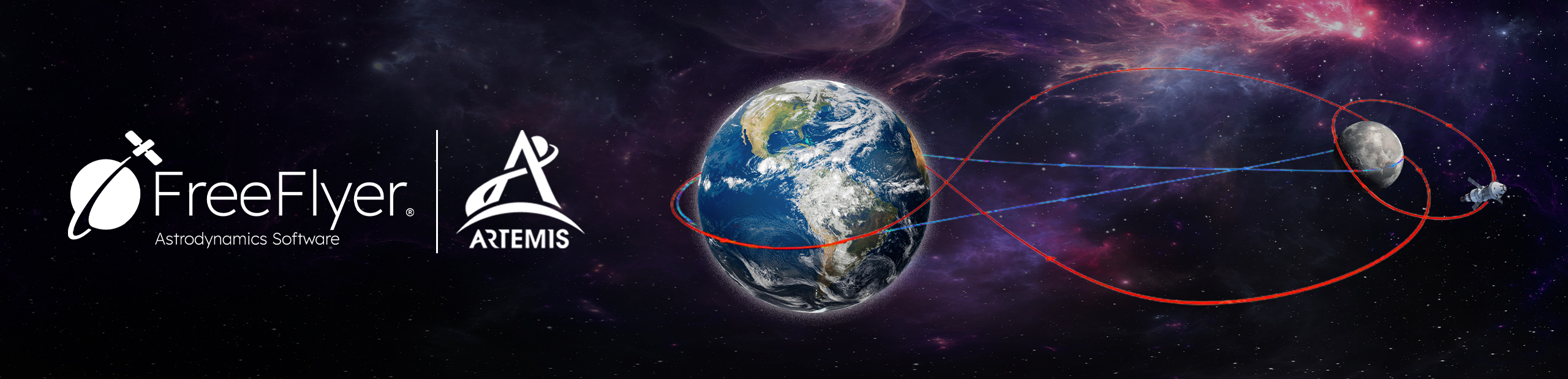
One answer is FreeFlyer, the astrodynamics software that has quietly guided human spaceflight missions, including those to the International Space Station and NASA’s Artemis I flight [4]. For Artemis II, FreeFlyer will serve as the astrodynamics engine for the flight controllers at NASA Johnson Space Center’s Mission Control Center in Houston, who will utilize FreeFlyer’s capabilities for real-time trajectory prediction, contact analysis, maneuver planning and targeting, along with other activities to ensure a safe flight for the crew.

With nearly 30 years of flight experience, FreeFlyer is a proven TRL-9 tool (flight-qualified) used by NASA, DoW, and commercial programs for trajectory design, orbit analysis, and operations [5]. FreeFlyer is a trusted workhorse that offers complete astrodynamics functionality for missions of any size and in any orbit regime [4], including cislunar missions.

As Artemis II ushers in a new era of lunar exploration, FreeFlyer brings with it a rich legacy of excellence in flight dynamics. From simulating translunar orbits to powering ground systems, FreeFlyer has been helping mission designers and flight controllers turn their bold Artemis objectives into reality.
In this series, we’ll explore how FreeFlyer’s capabilities, honed over decades of missions, are supporting Artemis II, from trajectory design and navigation for lunar Gateway operations to the eventual human exploration of Mars.
Stay tuned as we journey through the Artemis mission lifecycle and see how modern astrodynamics tools like FreeFlyer are enabling humanity’s return to the Moon and beyond [1][4].
References
https://www.nasa.gov/mission/artemis-ii/
[4] [5] a.i. solutions | Engineering Services and Products for Space Missions
Read more from a.i. solutions’ Artemis II series:

