

FreeFlyer Engineering Team
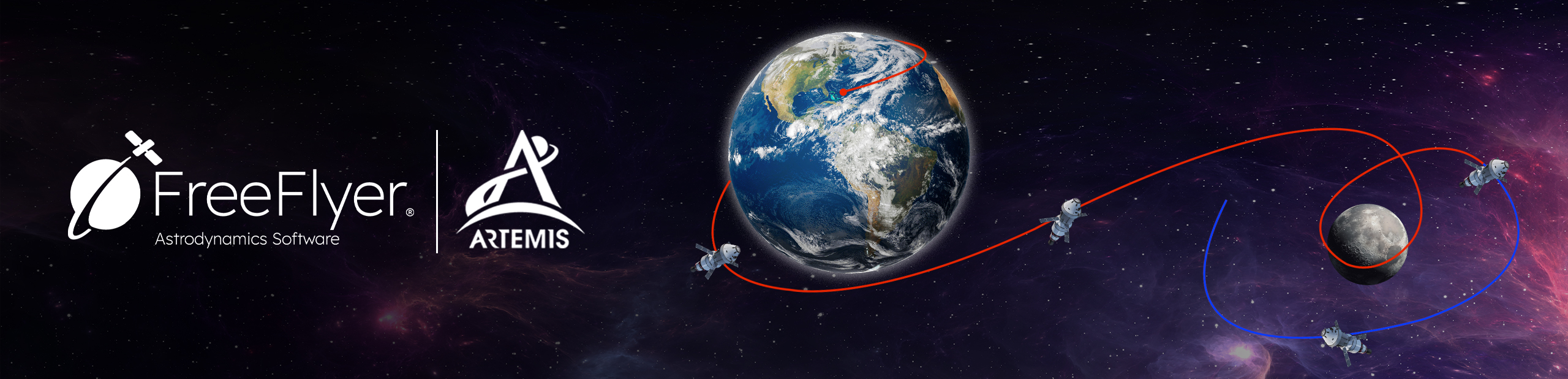
Designing a path to the Moon is not a simple “point A to point B” scenario. The Artemis II crew will loop around the Moon and return to Earth on a free-return trajectory. This means the flight path will naturally guide Orion back to Earth, a novel design approach also used during the Apollo missions.
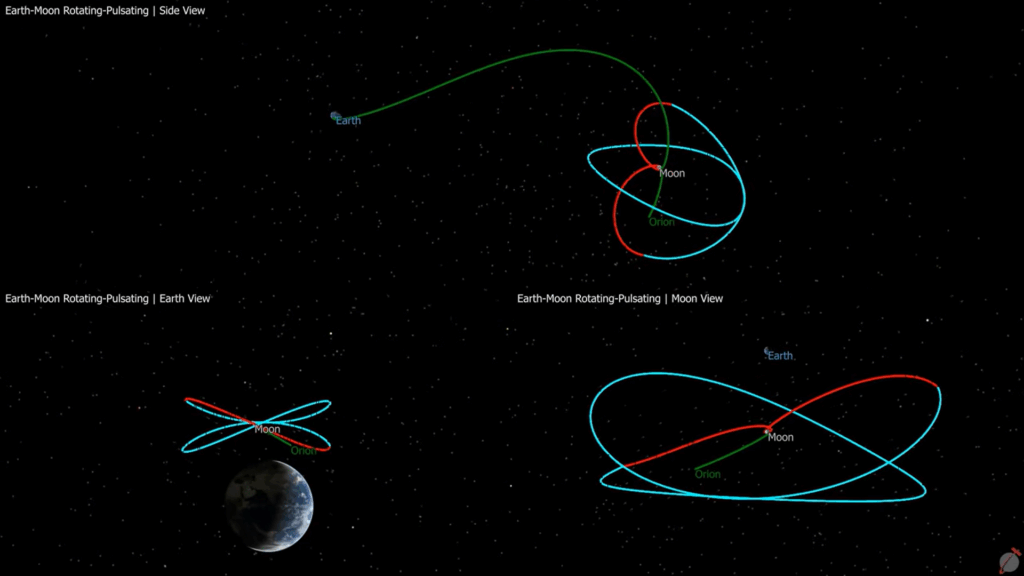
The complexity of such trajectories was leveraged in Artemis I. After launch, Orion performed multiple major burns to reach a distant retrograde orbit (DRO) about 40,000 miles from the Moon [1][2]. The spacecraft spent six days orbiting the Moon before performing another precisely timed burn to slingshot back toward Earth for splashdown [2]. This multi-phased journey relied on a delicate balancing act between the gravity of the Earth and the Moon and required precise planning to ensure Orion’s path was spot on.
The visualization below shows how Orion navigates the Earth–Moon system during Artemis missions.
NASA Artemis I Launch and Trajectory
FreeFlyer’s capabilities in trajectory design and simulation shine in this domain. FreeFlyer models complex cislunar trajectories with high-fidelity physics, accounting for the gravitational influences of Earth, the Moon, and the Sun, as well as non-gravitational forces like solar radiation pressure [3]. Using FreeFlyer, mission designers can simulate an entire end-to-end lunar mission: launch and parking orbit, the trans-lunar injection burn, mid-course corrections, lunar orbit insertion, and the return leg.
For Artemis I, Houston-based flight controllers used FreeFlyer to create lunar trajectory predictions, perform orbit determination, and analyze alternate mission profiles pre-launch and during real-time operations. NASA’s Johnson Space Center also uses FreeFlyer for many aspects of lunar mission design, including assessing low-energy transfer orbits, testing free-return paths, and designing abort scenarios. The software’s flexibility, such as scripting-based modeling and optimization, allows engineers to tweak maneuvers or coast phases and immediately see the effect on the trajectory and timing. This is crucial when your astronauts’ lives and mission success depend on following a precise orbit at the Moon and the return to Earth’s atmosphere at the correct entry conditions [1][3].
References
[1] [2] Artemis I, Flight Day 10: Orion Enters Distant Retrograde Orbit – NASA
[3] a.i. solutions | Fly to the Moon with FreeFlyer – a.i. solutions
https://ai-solutions.com/newsroom/lunar-lander/
Read more from a.i. solutions’ Artemis II series:

