

FreeFlyer Engineering Team
Artemis II is the first crewed mission to the Moon since Apollo 17 in 1972 and the inaugural crewed mission of the Artemis program. This mission is a critical step toward establishing a sustainable human presence on the Moon. Four astronauts, Reid Wiseman, Christina Koch, Victor Glover, and Jeremy Hansen, will launch from Kennedy Space Center, FL, aboard the Space Launch System (SLS) and take the Orion spacecraft on a free-return trajectory around the Moon. The mission will validate life-support systems, spacecraft performance, and crew operations in deep space before attempting a lunar landing on Artemis III.
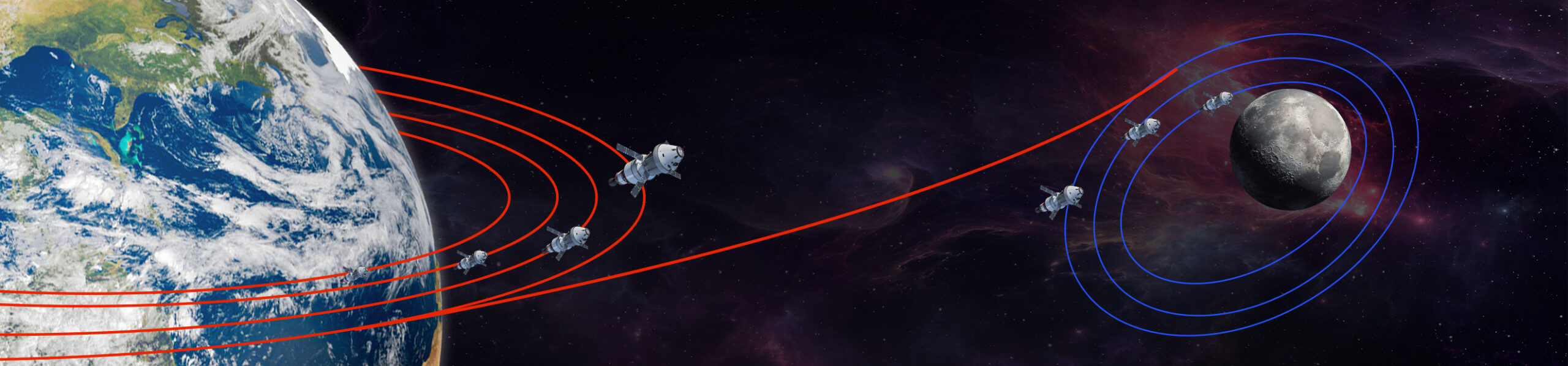
After burnout of the SLS booster, the Interim Cryogenic Propulsion Stage (ICPS) will perform two maneuvers: the perigee raise maneuver (PRM) and the Apogee Raise Burn (ARB). These maneuvers will place Orion in a 24-hour orbit around Earth, with an apogee of approximately 70,000 kilometers. Following the ARB, Orion will separate from the upper stage and perform a series of critical tests with ICPS for rendezvous, proximity operations, and docking that are essential to the success of the lunar landing in the Artemis III mission.
These tests will be completed before reaching apogee of the 24-hour orbit. Afterward, Orion will perform a small perigee raise burn (PRB) to adjust its trajectory for the Translunar Injection (TLI) burn, which will send the crew on a free-return trajectory around the Moon. The free-return trajectory leverages lunar gravity to slingshot Orion around the Moon and back toward splashdown off the coast of San Diego.
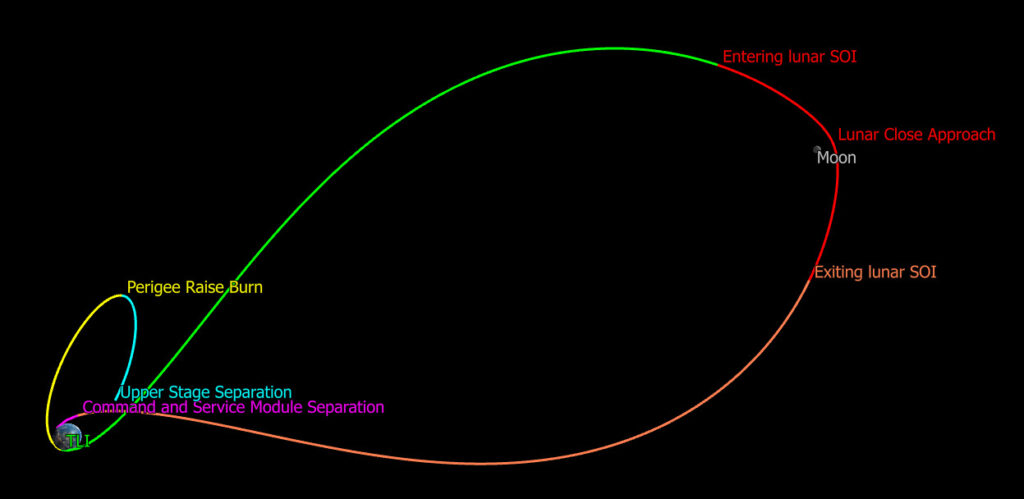
One benefit of the free-return trajectory is that it does not require any additional major maneuvers. The natural dynamics of the Moon align the trajectory to the reentry corridor. Additionally, small outbound trajectory corrections (OTCs) and return trajectory corrections (RTCs) can be performed pre- and post-flyby of the Moon to fine-tune the vehicle’s path.
During the free return, the crew will pass behind the Moon and be out of contact with Earth for 30-40 minutes. They will reach farther into space than any humans have before, reaching roughly 5,000 miles beyond the far side of the Moon. Just before splashdown, Orion’s service module will be jettisoned, and the capsule will enter the atmosphere at roughly 40 times the speed of sound. As it descends, the atmosphere will help slow the capsule, and parachutes will deploy to facilitate a safe landing. Recovery forces will retrieve the crew and the capsule from the Pacific Ocean.
This mission is a crucial part of the Artemis campaign aimed at ensuring that the life support, navigation, communications, and heat shield systems function effectively, enabling future missions to the lunar surface and the Gateway. The lessons learned from Artemis II will inform Artemis III and beyond, establishing a foundation for a long-term human presence beyond Earth’s orbit.
Read more from a.i. solutions’ Artemis II series:

